

Gourmet Sète-style rouille, intense-flavoured olive oil


Ingredients

- 1 kg cleaned and trimmed cuttlefish
- 2 c. à soupe Nîmes olive oil PDO
- 1 sprig of thyme
- 1 feuille bay leaf
- 1 zeste lemon
- 1 petit onion
- 25 cl dry white wine
- 1 a pinch of saffron
- Salt, pepper
- 600 g potatoes (such as Agria or Monalisa)
- 10 cl of single cream
- 2 c. à soupe Nîmes olive oil PDO
- 1 pincée saffron
- Salt, white pepper
- 1 jaune egg
- 3 gousses garlic, blanched twice
- 1 c. à café lemon juice
- 8 cl Languedoc olive oil PDO
- 1 c. à soupe reduced stock made from cooking cuttlefish
- 1 pointe saffron
- Salt
- A drop of squid ink
- 10 g of flour
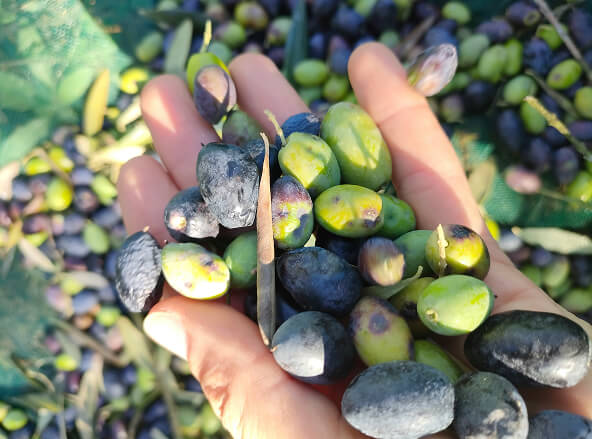
- 100 g black olives from Nyons PDO
- Herb shoots (fennel, rocket, chervil, etc.)
- Edible flowers
- Olive oil from Nîmes PDO
Astuce
Instructions
Cut the cuttlefish into small, even cubes (or use whole baby squid).
Fry them gently in PDO olive oil from Nîmes, along with the finely chopped onion, thyme, bay leaf and lemon zest, taking care not to brown them.
- Deglaze with white wine, add the saffron and season lightly with salt.
- Cover and leave to simmer over a low heat for 45 to 60 minutes. The cuttlefish should be tender but still hold their shape.
- Strain the cooking juices and set aside for the rouille and plating up.
- Cook the potatoes in salted water, then drain them.
Pass them through a potato ricer, then add the hot cream, the Nîmes olive oil PDO, the saffron, salt and white pepper.
- Beat until the mixture is very smooth and supple, almost mousse-like. Keep warm.
Stone the black Nyons olives (PDO). Chop them into small pieces, then place them on a baking tray and bake at 180°C for 10 minutes. Set aside.
In a bowl, blend the blanched garlic, egg yolk and lemon. Gradually drizzle in the Languedoc olive oil (PDO) to whisk the sauce until it resembles mayonnaise.
Thin with a little hot cuttlefish stock and flavour with saffron. The texture should be glossy yet light. Adjust the seasoning.
Mix the flour with 8cl of water and a drop of olive oil. Add the cuttlefish ink (the mixture will be very runny). Pour a little of the batter into a very hot frying pan. Cook on one side only for 3 to 5 minutes until the water has evaporated and the batter forms crisp, thin sheets. Place the cooked sheets on kitchen paper and leave to dry.
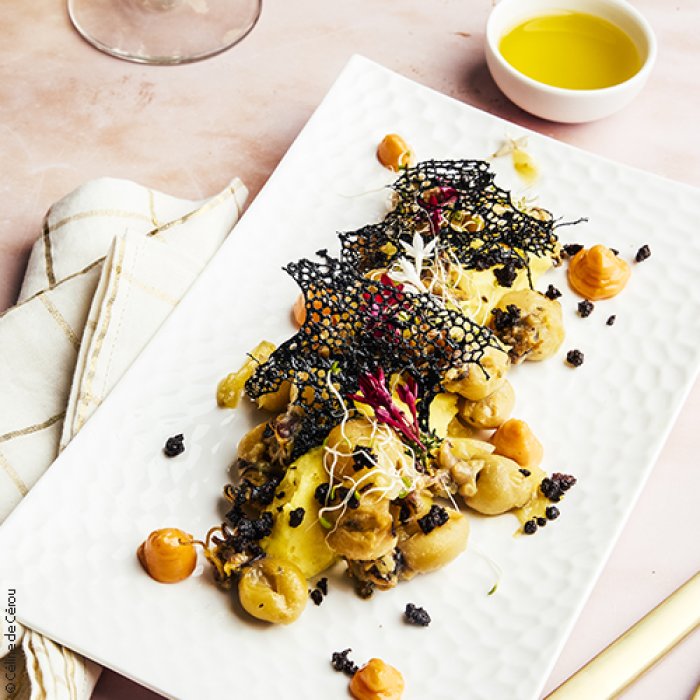
Place a quenelle of potato mousseline in a deep plate. Arrange the pieces of cuttlefish around it, drizzled with a little reduced sauce.
- Pipe a generous swirl of red icing next to or above the muslin.
Add a few pieces of cuttlefish ink tuile and sprinkle with crumbled, dried black Nyons olives (PDO).
Finish with a few sprouts, edible flowers and a drizzle of Nîmes olive oil (PDO) as a finishing touch.
Astuce
For this recipe, we recommend an PDO huile d'olive de Nîmes (intense flavour) for its herbaceous aromas and notes of hay, pineapple, yellow plum and raw artichoke, possibly complemented by red plum and apple.
Don’t have any? Then choose an intense-flavoured olive oil from another PDO range: huile d'olive de la Vallée des Baux-de-Provence PDO, PDO huile d'olive de Provence, PDO huile d'olive du Languedoc, PDO huile d'olive de Haute-Provence, PDO huile d'olive de Corse - Oliu di Corsica, PDO huile d'olive d'Aix-en-Provence.
For this recipe, choose a Languedoc olive oil (PDO) for its prominent notes of almond and tomato. You could also choose an Oliu di Corsica olive oil from Corsica (PDO), a Provence olive oil (PDO), an olive oil from Haute-Provence PDO, an olive oil from Aix-en-Provence PDO, an olive oil from the Vallée des Baux-de-Provence PDO or an olive oil from Nîmes PDO.
We recommend PDO olives noires de Nyons for their aromas of red berries, woodland, chocolate and even vanilla. You could also opt for olives noires de la Vallée des Baux-de-Provence PDO or olives de Nice PDO.
You might also be interested in