


PDO olive oils and olives in Spain
33 PDOs, 73,000 tonnes, 289 million euros: this is how Spain has turned its PDO olive oil into a discreet yet formidable force.
PDO olive oil in Spain: the giant that dares not speak its name
When we think of premium olive oil, our instinct is often to look to Italy. A strategic mistake. Spain, the world’s leading producer of olive oil period, has also quietly built up one of Europe’s most robust PDO (DOP, in the local version) sectors.

A sector that carries (a great deal of) weight — but remains small compared with the Spanish market
In 2024, Spain had 33 protected designations of origin for virgin olive oil. Together, these accounted for 73,102 tonnes of oil, with a market value of 289.52 million euros. This makes the sector one of the most well-organised and highly valued among all Spanish agricultural products bearing a quality label.
But let’s put this into perspective: Spain produces an average of 1.3 million tonnes of olive oil per year (with significant fluctuations in recent years due to drought). The 73,102 tonnes bearing the PDO label therefore represent only around 5 to 6 per cent of the total national volume. In other words, the vast majority of Spanish olive oil – the sort found in supermarkets under generic brands – is not certified. PDO remains a niche market, but one that has established a solid foothold: it commands a commercial value disproportionate to its volume, proof that consumers are willing to pay more for a product of guaranteed origin.
Three DOPs who do all the work
Of the 33 designations in the running, three account for more than half of the total:
- Baena PDO (Andalusia): 33.54 per cent of the sector’s total value (accounting for almost a third of the total on its own)
- Siurana PDO (Catalonia): 11.21 per cent
- PDO Priego de Córdoba (Andalusia): 9.79 per cent
Together, these three account for €129.56 million, or 54.54 per cent of the sector. In other words: out of 33 designations, just three are enough to keep the show on the road. The other 30 share the remainder, each with its own terroir story, but without (as yet) the same commercial clout.
Spain consumes all its own olive oil (or almost all of it)
Contrary to what one might expect from a country that exports vast quantities of its standard olive oil, Spain’s PDO remains, first and foremost… a Spanish affair. 85.08 per cent of the value generated by these oils remains within the domestic market. Exports, meanwhile, are split between 8.12 per cent to the rest of the European Union and 6.80 per cent to third countries.
The trend is nevertheless towards greater openness: since 2020, the value of exports has risen by 3.6 million euros, although the last two years have seen a slight slowdown. This is nothing dramatic; rather, it is the sort of up-and-down trajectory familiar to any product dependent on harvests and the weather.
PDO table olives in Spain: a very exclusive club
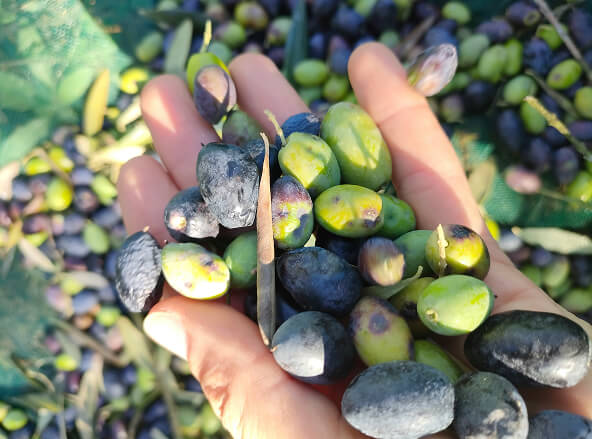
Whilst Spanish olive oil under the PDO designation is a heavyweight with its 33 designations, table olives are in a league of their own. Literally.
Four, not one more
Spain has 4 PDO varieties of table olives:
- Aceituna Aloreña de Málaga
- Aceituna de Mallorca / Mallorquina
- Manzanilla olive from Seville
- Aceituna Gordal de Sevilla
A select, almost exclusive group, compared to the country’s 33 olive oil designations. Total production of these four designations amounts to just 130 tonnes, with a market value of 0.55 million euros — barely 0.2 per cent of the value generated by PDO olive oil over the same year.
It is worth noting, incidentally, the sector’s strong Andalusian influence: three of the four designations come from southern Spain (Málaga and Seville), with the Mediterranean islands completing the picture with Majorca.

A purely Spanish affair
No passport is needed for these olives: 98.27 per cent of their value is consumed on the domestic market. Exports are virtually negligible — 1.55 per cent to the rest of the European Union, and just 0.18 per cent to third countries. In other words, if you want to try a genuine Aceituna Aloreña de Málaga PDO, the easiest thing to do is still to go and get it… in Spain.
Small but not insignificant
This limited scale is not a sign of weakness: rather, it is proof that PDO, in these two specific terroirs, is safeguarding a well-defined niche product, without seeking to conquer shop shelves worldwide.
For a table olive producer, securing one of these designations remains a clear means of adding value, less for the size of the target market than for the recognition of quality it confers, and the loyalty of a well-defined local customer base.
Why does it matter?
Beyond the figures, this sector sustains entire rural areas (mills, producers, local jobs) in regions where olive trees have shaped the landscape for centuries.
For a producer, aiming for an PDO means the assurance of entering a market that is already established and recognised.

- 32 olive oils, including Baena, Siurana, Les Garrigues, Aceite Campo de Calatrava, Aceite Campo de Montiel, Aceite de la Alcarria, Aceite de la Comunitat Valenciana, Aceite de la Rioja, Aceite de Lucena, Aceite de Navarra, Oli Mallorquí, Oli de Terra Alta, Oli del Baix Ebre-Montsià, Aceite del Bajo Aragón, Aceite Monterrubio, Aceite Sierra del Moncayo, Antequera, Estepa, Gata-Hurdes, Montes de Granada, Montes de Toledo, Montoro-Adamuz, Empordà Olive Oil, Poniente de Granada, Priego de Córdoba, Sierra de Cádiz, Sierra de Cazorla, Sierra de Segura, Sierra Mágina, Madrid Olive Oil, Somontano Olive Oil, Villuercas Ibores Jara Olive Oil
- 4 olives: Aloreña olive from Málaga, Mallorcan olive, Manzanilla olive from Seville, Gordal olive from Seville