


The basics of wine tasting: understanding and practising
What is tasting?
According to the Larousse dictionary, tasting is the act of ‘sampling a food or drink to appreciate its flavour and qualities’.
Tasting involves paying close attention to a product in order to appreciate its quality. It involves examining it through our senses – primarily taste and smell – to identify its flaws and reveal its qualities, and then to name them. In short, it is a process of studying, analysing, describing, judging and classifying.
Tasting is therefore not simply eating: it is a mindful and methodical process of consumption. We observe, describe and prioritise what we perceive, in order to establish the product’s organoleptic profile – its description through the senses.

It is thanks to our faculties of perception, identification and evaluation that tasting enables us to judge the quality of a product from three complementary perspectives:
- personal enjoyment (‘I like it / I don’t like it’),
- typical character (does the product remain true to its identity and origin?),
- technical quality (is the product well-made and free from defects?).
Today, this approach is essential for the marketing of many products: nothing can yet replace human perception. Humans remain the only ‘instrument’ capable of assessing certain organoleptic characteristics, whether good or bad.
This comprehensive profile enables us to fully appreciate a product’s value when consumed on its own, as part of a dish, or as a condiment.
Flavour: a multi-sensory alchemy
When we talk about tasting, we tend to think first of all of taste, and sometimes of smell. Yet all five senses can – and often must – be engaged, depending on the product.
A key term to remember: flavour. It encompasses all the perceptions that make up what is commonly referred to as the ‘taste’ of a food: flavours (perceived by the tongue), aromas (perceived by the nose, including through retro-olfaction) and tactile and trigeminal sensations (pungency, astringency, freshness, etc.).
Tasting is precisely about learning to untangle these threads to describe each one, and then appreciating the fabric they form together.
For each sensation perceived, the taster determines:
- its nature: sour, bitter, salty… for a taste; floral, woody, artichoke, almond… for an aroma; colour, brilliance… for sight;
- its intensity: whether the sensation is clearly perceptible, faint, or not at all (a scale specific to each type of product is used);
- its clarity: a blurred perception may indicate inappropriate tasting conditions… or a fault in the product.
Did you know?
The brain plays an active role in the formation of flavour.
Neurogastronomy has shown that perceiving an aroma is not a passive act: it is the brain which, using olfactory signals, ‘creates’ the sensation.
Tasting, therefore, is also about learning to focus one’s attention.
Did you know?
Contrary to popular belief, the best tasters do not have a ‘gift’: they have an excellent olfactory memory. The more smells you register, the better you can recognise them when they reappear in a product.
Hence the importance of paying attention, in everyday life, to all smells, whether pleasant or not.
The sense of smell
A smell results from a complex combination of odour molecules. A ‘rose’ scent may be caused by several molecules which, when smelled separately, would not evoke the scent of a rose. It is the brain that recognises the combination.
During the olfactory phase, perceptions are broken down into three stages:
- The intact product: odours perceived without touching or altering the product (inhaled directly from the glass or brought close to the nose).
- The deliberately ‘disturbed’ product: aerated in the case of wine, broken into pieces in the case of chocolate or Comté cheese. By breaking a piece of Comté or chocolate, new molecules are released, and thus new aromas.
- Retro-olfaction: the aromas perceived once the product is in the mouth. The successive inhalations we take carry the scent molecules from the mouth to the nasal passages. This is the central element of olive oil tasting: it is in the mouth that the bulk of its aromatic profile is revealed (artichoke, green almond, tomato leaf, freshly cut grass, apple, hazelnut, etc.).
The more descriptors there are, the easier it is to draw conclusions about the product’s profile. A genuine effort to expand one’s vocabulary is therefore necessary.
Taste
The word ‘flavour’ is constantly used interchangeably: ‘strawberry flavour’, ‘chocolate flavour’… whereas, strictly speaking, ‘flavour’ refers solely to the sensations perceived by the tongue. Marketing descriptions actually refer to aromas, which are perceived by the nose.
There are now five basic flavours:
- sweet, salty, sour, bitter;
- and umami, identified as early as 1908 by the Japanese researcher Kikunae Ikeda in kombu seaweed stock. Long considered an Asian peculiarity, it is now universally recognised as a fundamental flavour, found in particular in mature cheeses, tomatoes and olives;
The flavour of the future? Oleogustus, the ‘taste of fat’. Since 2015, researchers at Purdue University (United States) have shown that free fatty acids activate specific taste receptors on the tongue and propose recognising it as a sixth flavour. When perceived in isolation, it is rather unpleasant (a bit like a highly concentrated bitter taste); in small doses, it enriches a food’s flavour. Oleic acid, the predominant component in olive oil, is one such example. Could ‘oleogustus’ therefore soon be added to the list of basic tastes?
Tasting, therefore, involves identifying all the flavours present: a product may have none (water), just one (olive oil has only bitterness), several (acidity, sweetness and bitterness in a wine), or even all five.

Watch out, it’s a myth!
The famous ‘tongue map’ (sweet at the tip, bitter at the back…) dating from the early 20th century is incorrect: all areas of the tongue can detect the five tastes, albeit with slightly different levels of sensitivity.
Swishing the food around in your mouth is still useful, not to reach ‘specialised areas’, but to bring the food into contact with all the taste buds and stimulate retro-olfaction.
Touch
When tasting, this sense is first explored by the tongue, which, beyond flavours, perceives tactile sensations. Detecting these sensations is a physical phenomenon that sets the taste buds in motion: this is known as a kinesthetic sensation. Unlike taste, it can also be felt on the gums, cheeks or throat.
Some examples:
- the pungency of olive oil (a stinging sensation),
- the astringency of red wines,
- the creaminess of yoghurt,
- and, for lovers of long-aged cheeses, kokumi: this ‘sensation of texture’, enhanced by the peptides in very mature cheeses, is not a flavour in itself, but it lends body and depth to the flavour.
Swish the product around your mouth to appreciate its diversity and intensity.
Be careful, however: these sensations build up as the tasting progresses (they are said to be somatosensory). We therefore tend to overestimate the last product tasted, hence the importance of taking breaks and using neutralisers (water, green apple, etc.).
In practice
When it comes to olive oil, a slight bitterness is not a fault! It is the hallmark of the polyphenols found in oils made from olives harvested before they are fully ripe.
This pungency can be of two types:
- a ‘peppery’ sensation that tingles more or less intensely on the palate;
- and a burning sensation, like wasabi, mustard or chilli, which can vary in intensity, spread more or less widely across the mouth (sometimes down the throat) and gradually increase over time.
Key point: the pungency is greatly reduced when olive oil is used in a dish.
Appearance
The visual aspect does not directly contribute to the flavour, but the visual assessment provides valuable clues:
- in wine, brick-red hues reveal the oxidation of polyphenols and indicate the age of the product;
- in the case of Comté, the colour of the cheese reflects the season in which it was made: straw-yellow for summer production (rich in flowering meadows), pale yellow for winter.

The taster’s best practices
Tasting involves one or more of the senses, or even all five at once.
The challenge? Knowing how to pay attention to your perceptions whilst setting aside your personal preferences — ‘likes’ and ‘dislikes’ are best saved for the end.
Where?
In a neutral environment: no distracting smells (from the kitchen, perfumes, flowers), natural light if possible, and relative quiet.
Non-neutral conditions affect the reliability of our senses.
When?
Just before a meal, ideally before lunch, when you’re most receptive and least full.
Useful tip
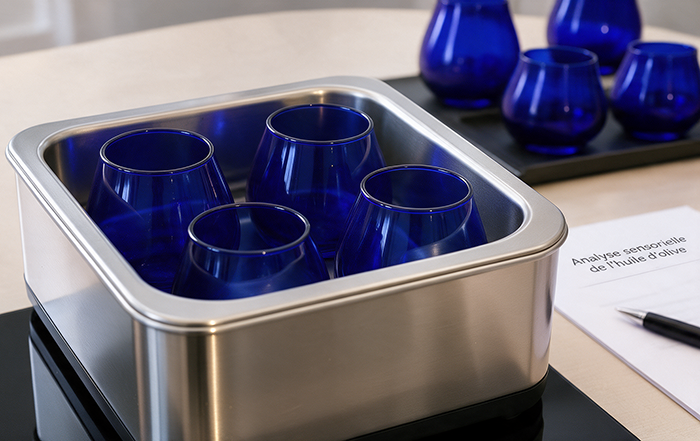
Olive oil is best enjoyed lukewarm (at around 28 °C, by warming the glass in the palm of your hand), at which temperature its aromas are fully released.
How can you avoid sensory fatigue?
Too much information can quickly overwhelm your sense of smell and taste.
A few golden rules:
- limit the number of products per session;
- take breaks between products;
- use neutralisers: lukewarm water, bread, green apple;
- vary the order of presentation (never present the same product first or last);
- start with the most delicate products and save the most intense ones for last.
Are you ready to get started?