

Why choose an PDO?
PDO isn’t just a red and gold logo that looks nice on the label! Behind these three letters lies a genuine commitment to quality, from the land to the plate. So, before you make your choice on the shelf, here’s why PDO deserves your full trust (and a bit of space in your shopping basket).
Regarding the label’s commitments
Choosing an PDO product means choosing transparency and high standards.
- Firstly, a simple but non-negotiable principle: the raw materials must come from a defined geographical area, and the processing must take place within that same geographical area – there is no way to cheat on the geography.
- Secondly, producers are committed to adhering to precise specifications approved by the European Union: nothing is left to chance – neither the varieties, nor the methods, nor the expertise.
- Finally, the icing on the cake (or rather, the olive on the platter), these commitments are not based on good faith alone: state-certified bodies come to verify, inspect and guarantee that everything is in full compliance.
In short, with PDO, quality isn’t just claimed – it’s proven.

To provide practical support for the local economy

Buying an PDO product also means using your purchasing power to support an economic model rooted in local communities. Because production must remain linked to a specific region, the PDO prevents relocations and keeps business – and jobs – where the product has always been made.
Mills, farms, processing workshops: an entire rural economic fabric thrives thanks to this requirement for local production.
An PDO cheese or olive oil cannot be produced elsewhere to cut costs; this is precisely what makes it a valuable ally for the vitality of the countryside.
Choosing PDO also means choosing to preserve something that cannot be found anywhere else.
For the environment and biodiversity
The PDO not only protects traditional know-how, it also preserves a living heritage.
By requiring the use of traditional varieties and cultivation methods specific to a particular terroir, it helps to maintain agricultural biodiversity that might otherwise have disappeared in favour of more standardised or more profitable varieties.
Growing a local variety of olive or grape that has been cultivated for generations is not a nostalgic choice: it is a bulwark against the standardisation of crops, and often a guarantee of farming practices better suited to the specific characteristics of the local soil and climate.

To ensure flavour and authenticity
An PDO product is a one-of-a-kind product!

With the terroir as the source of its character
The distinctive characteristics of a product in PDO are linked, in part, to its terroir. This is why a geographical area is strictly defined and regulated, as this area corresponds to the specific climatic and geological conditions that characterise the product. In other words, it is the soil, the climate and the specific environment of the area that give the product its unique flavour profile.
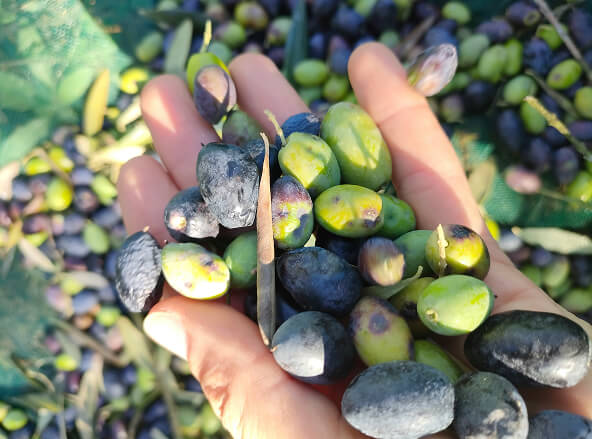
An olive oil from Nyons will not have the same profile as one from Nice or the Vallée des Baux, precisely because the terroir differs.
And expertise as a guarantee of consistency
The human factor – through experience, expertise and dedication – has enabled the product to become what it is today. This expertise is not left to chance: its broad outlines are set out in the appellation’s specifications. It is these precise specifications (harvesting, extraction and production methods specific to the area) that ensure the product retains, year after year, the characteristics that define its distinctiveness.
In summary:
- The terroir is the source of the product’s distinctive flavour (natural factors)
- Expertise ensures that this flavour is reproduced and preserved over time, as it is formalised in the specification
This is what distinguishes PDO from a mere ‘regional product’: it is not just a geographical indication; it attests to an established and monitored link between the terroir, human expertise and the final product.

The challenges facing food quality systems
PDO, PGI, TSG… food quality schemes play a vital role in promoting and protecting agricultural and food products.
They help to preserve the origin, traditional know-how and specific characteristics that make many European products unique.
These schemes make it easier for consumers to identify quality products with distinctive characteristics.
Furthermore, they enable producers to better promote and market their products both on the European market and internationally.
Finally, these schemes contribute to the vitality of rural areas by supporting local supply chains and the communities that depend on them.