

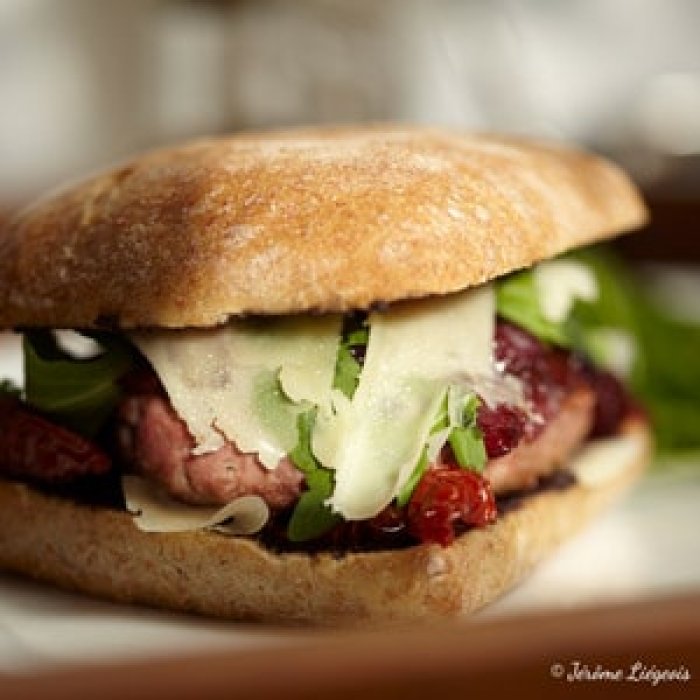
Ciabatta burger: ‘when the South-West meets Provence’


Ingredients

- 520 g of flour
- 10 g salt
- 5 grams of baker’s yeast (dried)
- 35 g of full-flavoured olive oil
- 300 g of water
- 1 pinch of sugar
- 400 g red onions
- 3 tablespoons of balsamic vinegar
- 1 teaspoon of caster sugar
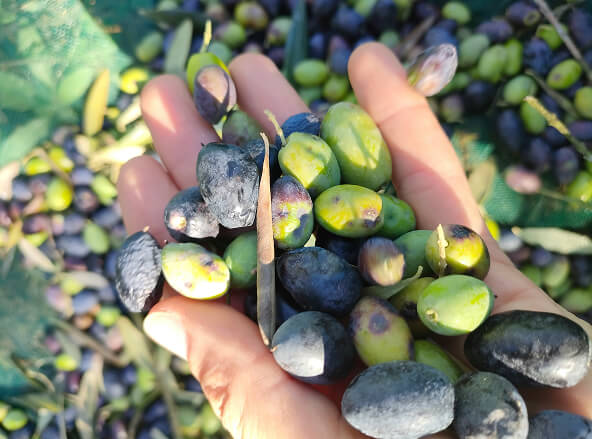
- 50 g pitted green Lucca olives
- 3 tablespoons of mild-flavoured olive oil
- Salt, pepper
- 4 duck burgers
- 8 to 12 teaspoons of onion confit (homemade or shop-bought)
- 8 dried tomatoes
- 4 tbsp black olive tapenade (recipe on our website)
- Intense-flavoured olive oil
- Cantal
- Salt, pepper
- Rocket
Tip
Instructions
- In a large bowl, combine the water, baker’s yeast and sugar, mix together and leave to rest for 5 to 10 minutes to allow the yeast to activate (preferably near a warm place such as a radiator).
- Meanwhile, mix the salt and flour in a mixing bowl or in the bowl of your food processor (if you have one fitted with a dough hook).
Or using a food processor: Add the yeast mixture to the flour and salt mixture, add the olive oil and knead on high speed for about 15 minutes, until the dough is no longer sticky.
Either by hand: Mix the two mixtures (yeast / water / sugar + flour / salt) with the olive oil; this will result in a very sticky mixture. Dust your work surface with flour and place the dough on it. Knead the dough until it no longer sticks (the dough should be elastic but not sticky).
- Next, place the dough in a mixing bowl (or leave it in the food processor bowl) and cover with a clean tea towel. Leave to rest at room temperature for 1 hour.
- Next, place the dough on the work surface, fold it over once (folding it in half), then a second time (folding it in half but in the opposite direction).
- Leave to rest for another hour at room temperature, covered with a clean tea towel (or cling film).
- On a floured sheet of baking paper, spread the dough evenly with your fingertips (taking care not to press it down too much), then cover it with cling film. Leave to rest for 1 hour at 24–25 °C.
- Preheat your oven to 225 °C. Cut the dough into squares. Dust each roll with flour, then place them on a baking tray. Bake for 25 minutes. The rolls are ready when they have a nice golden crust. Leave them to cool before serving.
Peel and finely slice the onions. Heat a frying pan with 3 tablespoons of olive oil, then add the onions.
- Fry them over a high heat, making sure they don’t stick (if they do, add a spoonful of water). When the onions are translucent, deglaze with the balsamic vinegar. Reduce the heat, then add a teaspoon of sugar and leave to simmer for a further 15 minutes.
- Chop the olives and add them to the onions once they are nearly cooked (wait until the onions have cooled down a little). Season with salt and pepper to taste.
Blanch your dried tomatoes for 30 seconds. Then pat them dry on kitchen paper and slice them into strips. Place them in a bowl and cover them with 2 tablespoons of full-flavoured olive oil. Set aside.
- Cut the Cantal into shavings and set aside.
- Cut your bread rolls in half and pop them in the oven for a few minutes (leave your oven on for the final part of the recipe).
- Cook your duck steaks on both sides.
- Assemble your burgers: spread some tapenade on both halves of your bun, then place a patty on each bottom half of the bun, spread 2 to 3 teaspoons of onion confit, top with a few sun-dried tomatoes and then the Cantal shavings, finally place the top half of the bun on top and bake in the oven for 3 to 4 minutes.
Finally, open the burgers again and top with a few rocket leaves before serving. Serve immediately.
Tip
The PDO olive Lucques du Languedoc is a green olive characterised by subtle aromas of buttery avocado and, at times, even fresh hazelnut or freshly cut hay. Tender and melt-in-the-mouth, this olive is also mild. It is ideal for this recipe; however, if you do not have any, you can opt for olives de Nîmes PDO or olives cassées de la Vallée des Baux-de-Provence PDO.
You might also be interested in