


Olives de Nîmes PDO
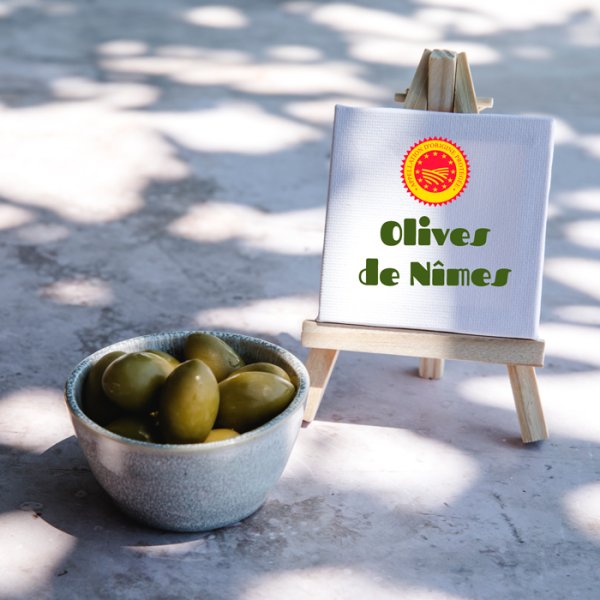

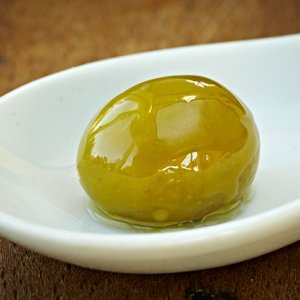
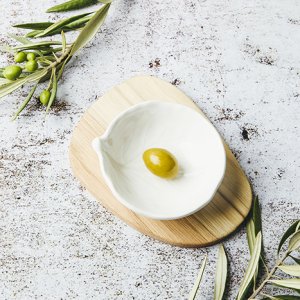
Of the Picholine variety, it is harvested in September (until early October). It is a whole olive with a bright green colour, characterised by a smooth skin and a firm texture, with no stalk. It has a distinctive crunch, is juicy, and offers typical buttery and nutty aromas on the palate, along with a salty flavour.
What do Olives de Nîmes PDO taste like?
The PDO olive de Nîmes is a whole olive of a vivid green colour, characterised by a smooth skin and a firm texture, without a stalk, and is exclusively of the Picholine variety.
It is a characteristically crunchy, juicy olive, with typical buttery and nutty flavours on the palate and a salty taste. It is neither cracked nor scored.
The olives are graded at a maximum of 34 fruits per 100 grams. Batches must be uniform in colour and size.
From the very first bite, the PDO olive de Nîmes captivates with its crunch: its firm flesh gives way with a distinct snap. It is also juicy and full-bodied on the palate, without any harsh bitterness.
In terms of flavour, the Picholine variety reveals delicate notes of butter and hazelnut, enhanced by a well-balanced salty flavour.
It is always whole, neither broken nor cut, and of a uniform size (a maximum of 34 olives per 100 g).
Physical characteristics
The Olives de Nîmes PDO variety
Olives bearing the ‘Olive de Nîmes’ designation come exclusively from the Picholine variety, which is recognisable by its elongated shape and firm, crunchy flesh.
To encourage fruit set, pollinator olive trees may be planted in each orchard, provided they are arranged harmoniously and do not exceed 5 per cent of the total number of trees.
Harvesting Olives de Nîmes PDO
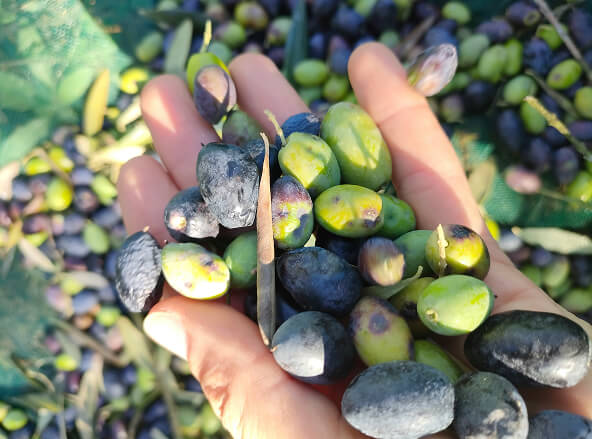
The olives come from trees that have been growing on the plot for at least five years. They are picked by hand before their green colour turns to yellow-green, which ensures they remain firm and crunchy. The use of ripening agents is prohibited: here, the olives are picked naturally; they are not forced to ripen.
The olives are then stored and transported in perforated crates holding a maximum of 20 kg. Time is of the essence: no more than 48 hours between harvest and arrival at the processing facility, followed by no more than 48 hours before preparation.
After brining, the olives are preserved using one of the authorised methods: refrigeration at between +3 °C and +8 °C, brine with a higher salt content (maximum density of 1069), pasteurisation, a protective atmosphere or inert gas.
Finally, for sale to the consumer, the olives are packaged in containers with a maximum gross weight of 12.5 kg, equivalent to 8 kg net drained weight.
From September to October
Preparation method
In brine
The olives are graded and sorted before any processing takes place: a maximum of 34 olives per hectogram, in batches that are uniform in colour and size. Defects (stained, soft or shrivelled olives, stems, fungal damage, etc.) must not exceed 3 per cent of the olives, and insect bites – particularly those from the olive fly with exit holes – are limited to 1 per cent.
They are prepared using the traditional ‘reduced lactic fermentation’ method: left whole, they are macerated in an alkaline solution of potash or soda (maximum density of 1032) until partially de-bittered. They are then left for at least thirty-six hours in clear, potable water, with at least four rinses.
Finally, they are placed in brine with sea salt (maximum density of 1060). Citric and lactic acids are permitted to lower the pH to a maximum value of 4.7.
By the numbers
Specifications
Specifications - Nîmes PDO OliveHow to cook with Olives de Nîmes PDO
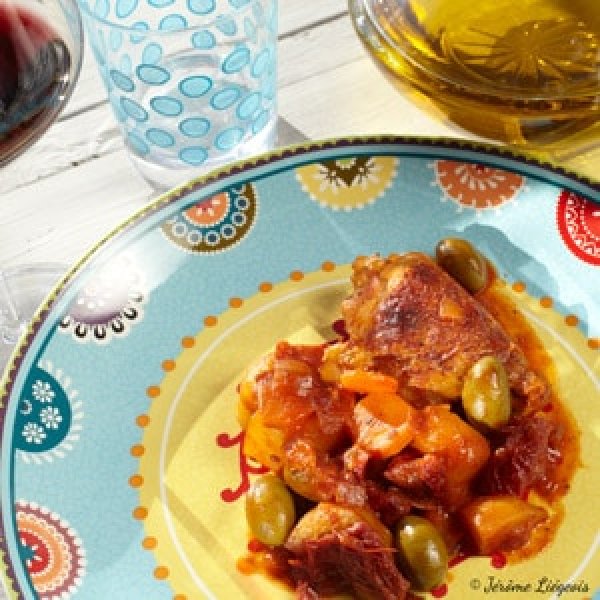
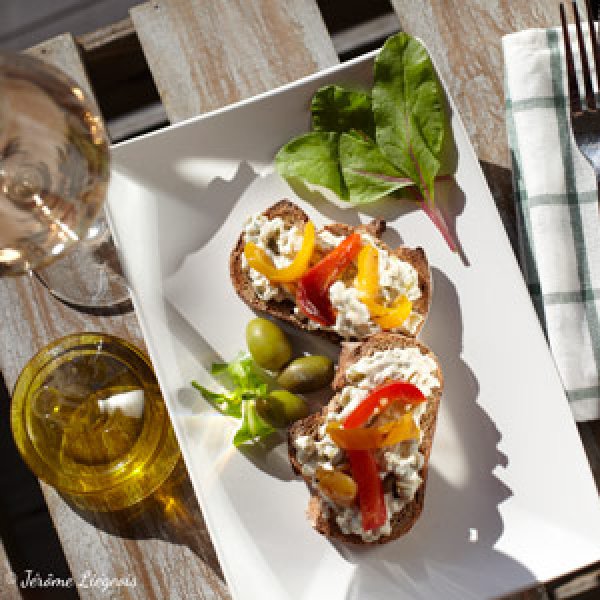
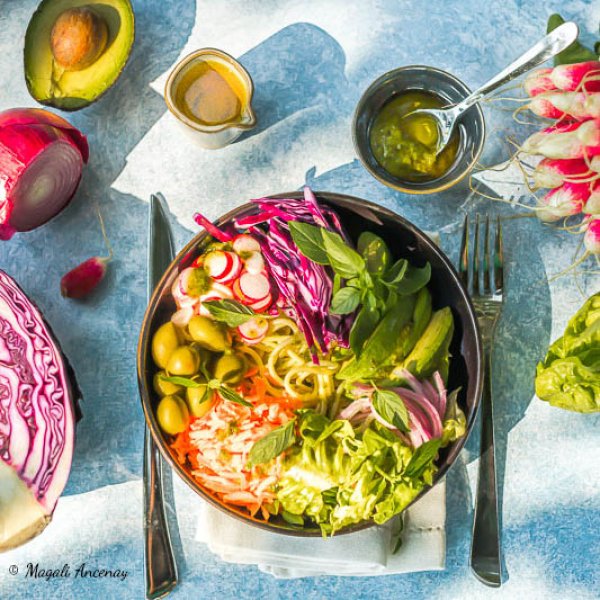
Perfect for any aperitif, the PDO olive de Nîmes is ideal for preparing traditional dishes (rabbit stew, chicken with olives, tagine), in your salads or to add a crunchy texture to original savoury open sandwiches and savoury pancakes...
Discover Huile d'olive de Nîmes PDO
Discover the terroir of Nîmes