

‘Store away from light and heat’ is the phrase that appears on all bottles of olive oil sold in France and across Europe.

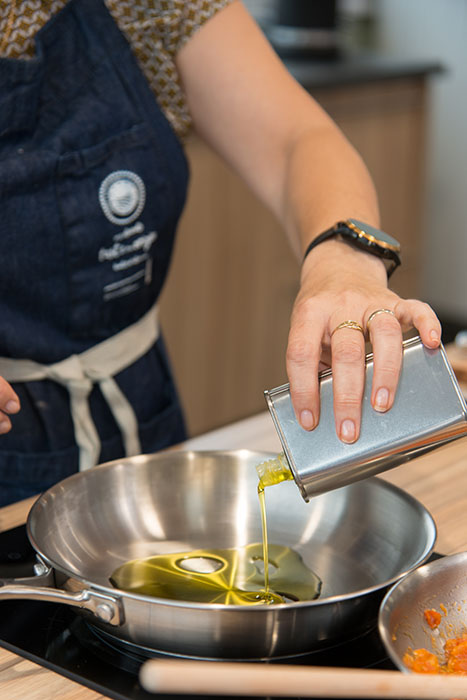
Can I use my olive oil for cooking?
Numerous scientific studies have indeed shown that light and heat during storage have a negative impact on the quality of olive oils. In particular, high storage temperatures degrade the sensory profile of olive oils. This means that your bottle should be kept in a cupboard at an ideal temperature of around 20°C; if this temperature cannot be maintained, you can store it in a wine cellar (temperature: 10 to 12°C).
This information therefore relates to the storage of olive oil, not to its use in cooking.
To find out whether olive oil can be heated, you need to look at its smoke point. This is the temperature at which smoke begins to appear when a fat is heated. When this temperature is reached or exceeded, harmful, toxic or even carcinogenic substances are produced, such as benzopyrenes and acrolein. It is therefore this temperature that determines whether a fat can be heated or not.
And you know what?
The smoke point of olive oil is around 210°C. You can therefore use olive oil for cooking and even for deep-frying without any health concerns, as the typical deep-frying temperature is 180°C.
Cooking with olive oil therefore poses no health risks (provided you eat a balanced diet and don’t live on fried food alone!!!); however, prolonged cooking or cooking at high temperatures causes the olive oil’s aromas to diminish. It is therefore advisable to use local olive oils (PDO, single-variety, etc.) at the end of cooking, for short cooking times (eggs, for example) or for cooking foods that absorb flavours (such as potatoes).
A few tips
To make the most of the benefits and qualities of olive oil:
- You can use olive oil in all kinds of dishes: cold, hot, fried and baked;
- Ideally, add local olive oils at the end of cooking; this allows the olive oil’s flavours to develop and blend with those of your dish;
- Use a ‘classic’ virgin or extra virgin olive oil for all types of cooking, particularly slow cooking;
- You can also use local olive oils in cold dishes, pastries and dishes requiring short cooking times (particularly when cooking eggs).
And for deep-frying:
- Keep the temperature to a maximum of 180°C; this is more than enough and prevents the oil from going rancid.
- After use, strain the oil to remove any debris so that it does not burn when you next use it.
- Store used oil in a cool place, away from air and light, to prevent oxidation.
- Change your oil after 5 to 6 uses and no later than 3 months after the first use.
Discover all our recipes by clicking here!